
Harris County Parole Versus Probation
Texas parole is supervised release from a state prison sentence. The Texas Board of Pardons and Paroles, commonly called BPP, makes the release decision. The TDCJ Parole Division then supervises the person in the community. Mandatory supervision is also a state release form, but its legal basis and eligibility rules differ from parole. Neither term means the sentence has ended. A person can leave prison, report to a parole officer, and remain under the authority of the state until discharge.
Probation is different. Texas law commonly calls it community supervision. A Harris County criminal court imposes it, and the Harris County Community Supervision and Corrections Department, or CSCD, administers it. A person may leave the county jail directly onto probation. Another person may receive probation without entering state prison at all. That is why a parole office should not be asked to verify an ordinary Harris County probation case.
| Point | Parole or mandatory supervision | Probation |
|---|---|---|
| Source | Release from a TDCJ sentence | Order from the criminal court |
| Decision maker | Texas Board of Pardons and Paroles under state law | Judge in the Harris County case |
| Supervising body | TDCJ Parole Division | Harris County CSCD |
| First record to check | TDCJ number, SID, BPP status, and release certificate | Cause number, judgment, docket, and CSCD assignment |
| End of supervision | TDCJ discharge or other lawful end of sentence | Court termination or discharge order |
- Parole
- Conditional release from prison before the sentence reaches its final end date.
- Probation
- Court-ordered community supervision, often used instead of confinement.
- Discharge
- The legal end of the sentence or supervision obligation.
- Absconder
- A person alleged to have stopped reporting or whose location is unknown to the supervising agency.
Check Harris County Supervision Status
Begin with the custody path, not a guess. A Harris County booking may end in a community release, a county probation order, transfer to TDCJ, or transfer to another agency. For a state case, retain the seven-digit TDCJ number or State Identification number, known as the SID. Those identifiers separate people with similar names and connect records across custody periods. For probation, use the Harris County cause number and court because public information about an individual supervisee may be limited.
- Identify the case and custody system. Read the HCSO booking result and court docket. A commitment to TDCJ points to state parole channels; a community-supervision judgment points to Harris County CSCD.
- Check state release processing. Use the official TDCJ and BPP information routes with the TDCJ number, SID, full name, and date of birth. Ask whether release to supervision occurred, which office holds the case, and whether the sentence is discharged.
- Check county probation. Search the correct Harris County court docket by cause number, then contact Harris County CSCD for the correct unit or reporting channel.
- Confirm the document. A release certificate supplied by the releasee can show the date and conditions of state supervised release. A court termination order is stronger proof that probation ended than the original sentence entry.
- Recheck current status. A projected date, parole vote, or old docket entry may not reflect a later hold, violation, or discharge.
For the larger custody and release trail, the Harris County released-inmate search explains how HCSO, court, TDCJ, federal, and immigration records fit together.
Harris County Parole Office Routing
Harris County is within TDCJ Parole Region III. The official directory lists Houston district offices as well as Pasadena and Webster offices. Assignment depends on a person's residence, supervision plan, and program. No single Houston office should be published as a person's supervisor without confirmation. The Region III office or the office named in a current TDCJ record can route a lawful inquiry.
TDCJ Parole Region III
10110 Northwest Freeway
Houston, TX 77092
713-685-7177
The official Houston-area parole directory shows the network used for local assignments.
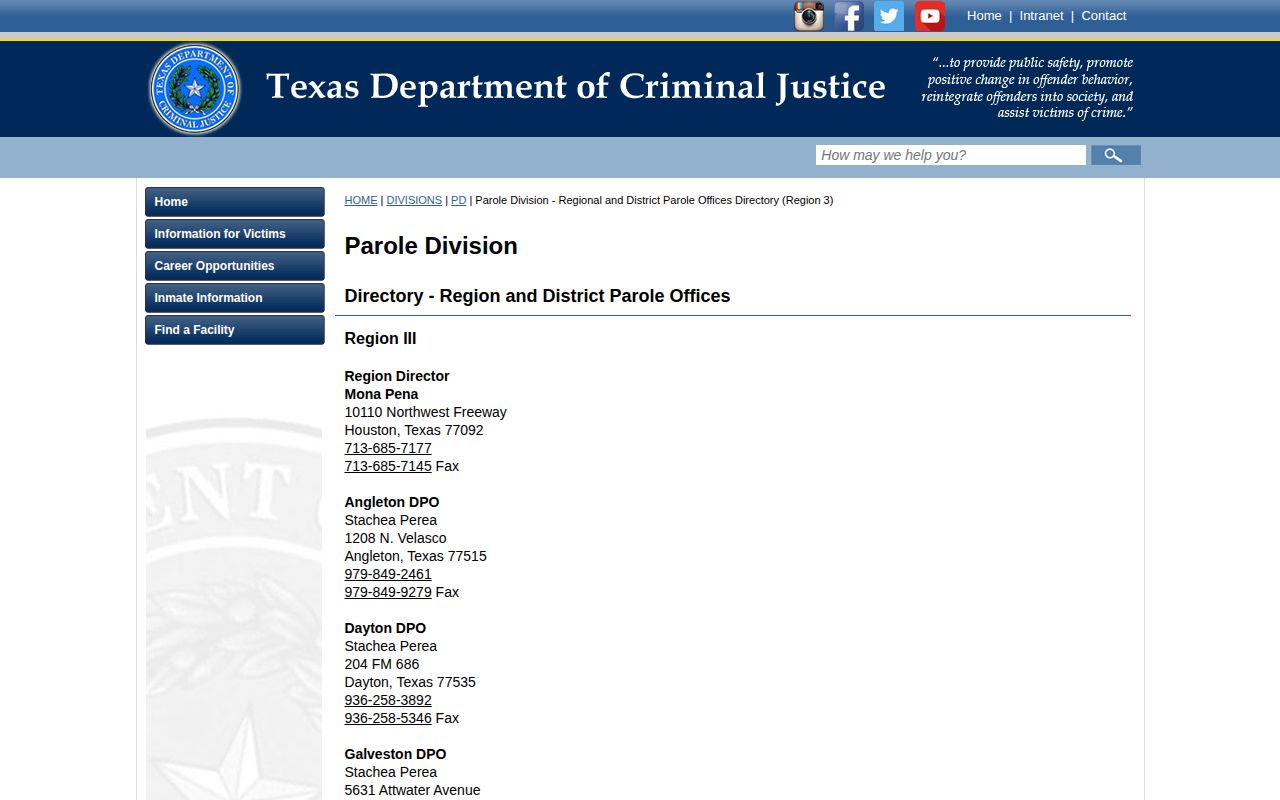
The directory matters because office names and assignments can change. Use it to locate the right routing office, then provide the identifiers needed for the agency to determine what it may disclose.
Harris County CSCD is the separate local route for probation. Start with its official site and the case docket. The court number, cause number, and judgment help staff distinguish one supervision order from another. Do not send county probation questions to BPP merely because the person once spent time in jail.
Harris County Parole Decision Records
BPP outcomes use codes that are more exact than the words granted or denied. A favorable FI code may require an investigation, a treatment program, or another release condition before a person can leave custody. NR generally denotes denial with a later review date. SA is a serve-all outcome under the stated code. DMS concerns denial of mandatory supervision with later handling as the code provides. The exact notice controls.
A favorable result may also be reconsidered when new case, protest, or disciplinary information arrives. Texas does not hold a public courtroom-style hearing for every initial parole review. Panels review files and vote, so a public meeting calendar is not a list of individual Harris County release hearings. The official BPP vote-options page should be used to interpret the current code.
There is no verified statewide public name search for ordinary people already on parole. Individual parole and releasee information is broadly confidential under Government Code §508.313, subject to listed disclosures. A person checking a known case should use official status channels and the assigned Parole Division office for information that can lawfully be given.
Note: Parole eligibility opens review; it does not guarantee approval, issue a certificate, or establish a physical release date.
Harris County Supervision Violations
Conditions can include reporting, travel limits, treatment, program attendance, and other terms stated in the controlling order or release certificate. The exact conditions are person-specific. A violation allegation may lead to closer supervision, a program, an intermediate sanction, a warrant, or a revocation process. It should not be restated as a final finding before the responsible body acts.
An absconder is someone alleged to have stopped reporting or who cannot be located. The label does not establish a new conviction. TDCJ maintains a public absconder search for a narrow subset of supervised sex offenders. The Texas DPS registry is also limited to people with a legal duty to register. Neither database is a general list of all parolees or probationers in Harris County.
A warrant creates renewed arrest exposure. It does not erase the earlier release event. Following an arrest on a parole matter, the Board may continue or modify supervision, impose an intermediate response, transfer the person, or revoke release. For a county probation matter, the Harris County court docket is the sound place to look for a motion, warrant, hearing, or later order.
Harris County Reentry Supervision
The Southeast Texas Transitional Center at 10950 Beaumont Highway is a Houston residential reentry center listed by TDCJ. Placement there can occur after a person leaves prison while parole authority continues. It is not a county jail, and residence there does not prove that the sentence has been discharged. The assigned parole office remains the correct source for supervision routing.
A residential reentry center supports a staged return to the community. The custody label, release certificate, and office assignment should be read together. Someone may be out of a prison unit yet still face reporting rules and a structured placement. Conversely, leaving the center does not by itself show that all supervision has ended.
Use the TDCJ Residential Reentry Centers list to confirm the facility's current status. Then ask the parole office whether the person remains under supervision and what public confirmation is available.
Note: A reentry placement describes where a person lives during supervision, not whether the underlying sentence has reached discharge.
Property After Harris County Release
Release planning can overlap with an HCSO property pickup even when the later supervision is handled elsewhere. Current HCSO guidance says an authorized recipient first appears at the housing facility between 8 a.m. and 9 p.m. with identification. The incarcerated person must authorize the release. A deputy then issues a Property Release Form and directs the recipient to 700 North San Jacinto. The form is valid for 24 hours.
This procedure is for an authorized designee. It is not a broad right to collect another person's property. It also should not be confused with parole-office reporting or with property that TDCJ returns during a prison release. Check the live HCSO release and property instructions before making the trip because older archived instructions materially differ.
Confirm Harris County Supervision Discharge
Supervision ends through an official act, not through silence in a web search. For a TDCJ sentence, ask whether the sentence was discharged and request releasable incarceration or release information through TDCJ. Maximum sentence date, projected release date, parole eligibility, scheduled release, actual release, and discharge each mean something different. Only discharge states that the sentence obligation has ended.
For probation, inspect the Harris County docket for a termination or discharge order. The original judgment proves that community supervision was imposed, but it does not prove successful completion. A later order can reflect completion, early termination, modification, extension, or revocation. Obtain a certified copy from the correct clerk when the legal outcome must be documented.
IVSS Counties may send a release, transfer, or return-to-custody notice, but it is not an official record. Keep the notice as a prompt to verify. The county release sheet, TDCJ release certificate, supervision discharge record, or court order provides the firmer trail.