
Harris County Release Date Types
A projected release date is a forecast based on the sentence, offense, law, and current record. TDCJ says its Classification and Records Office calculates the date on which a prisoner is projected to leave incarceration if not paroled sooner. The field may change. It is not proof that someone walked out that day.
A scheduled date appears at a later stage, after TDCJ audits a release certificate. Even that date may change without notice. Maximum sentence date is the sentence endpoint after applicable calculations. Parole eligibility only opens review. Actual release looks backward and confirms that custody ended or shifted.
Find Harris County Projected Dates
Classify the sentence first. A person awaiting trial has no sentence-based end date. Bond, a court order, dismissal, or a hold may change custody at once. For a county jail sentence, use the signed judgment, credit for time confined, and HCSO calculation. For a state sentence, use the TDCJ number or SID.
- Determine whether the person is pretrial, county-sentenced, or TDCJ-sentenced.
- Obtain the judgment and note the offense, sentence, custody credit, and county.
- Open the TDCJ inmate search for state custody.
- Record each label exactly: projected release, maximum sentence, parole eligibility, current unit, and scheduled location.
- For county time, request the jail-time computation or commitment record.
- Ask whether a hold, consecutive term, audit, or parole action remains unresolved.
- Confirm the actual event through the agency on the day.
TDCJ's search is current-custody oriented and updates on working days with information at least 24 hours old. A former prisoner normally drops out. Disappearance cannot prove release because an input error, lag, or transfer may cause it.
Texas Good Time Release Rules
Texas Government Code Chapter 498 governs TDCJ good-conduct time. Section 498.003 authorizes credits. Section 498.004 makes good time a privilege, not a vested right, and permits forfeiture. Section 498.005 limits restoration. Good time does not reduce the sentence itself. It affects eligibility or custody dates only as law permits.
Texas has no blanket requirement that all state prisoners serve 85 percent. Under Government Code §508.145(d), listed serious-offense cases may require actual calendar time equal to the lesser of half the sentence or 30 years before parole eligibility, without good time counting toward that minimum. Other subsections differ. Offense, finding, date, sentence, and prior history matter.
Government Code Chapter 508 lists mandatory-supervision exclusions. Eligibility is not approval. A BPP denial can move a projected date toward maximum expiration.
Harris County Date Change Factors
Release calculations move when their legal or factual inputs change. Some changes alter eligibility. Others delay physical exit without changing the sentence end.
| Factor | Possible effect |
|---|---|
| Good-conduct credit | Affects eligibility or custody date where statutes permit. |
| Disciplinary loss | Can remove credits and change a TDCJ projection. |
| BPP action | Can approve, deny, add conditions, or set later review. |
| Detainer or hold | May route the person to another agency. |
| Corrected jail credit | Changes the calculation input. |
| Concurrent or consecutive terms | Changes how several sentences run. |
| Records audit | Can correct a schedule or location. |
A detainer is another authority's request for notice or custody. Release from HCSO or TDCJ under a detainer is a transfer, not proof of community release.
Confirm Harris County Actual Release
A TDCJ release certificate is strong evidence of actual supervised release when the releasee supplies it for a personal or legal need. It records conditions reviewed at release. For county custody, use the HCSO OUT DATE, direct confirmation, and booking/release sheet. A court judgment supplies the sentence, but not the exact time the jail opened the door.
Register through the Harris County VINE inmate check for an alert, then verify with the responsible agency. IVSS is not an official record. A projected date, favorable parole vote, or notice should never be restated as an actual release without confirmation.
Harris County Jail Date Math
Do not apply TDCJ's prison formula to a Harris County jail sentence. Texas Code of Criminal Procedure article 42.032 addresses county-jail good conduct for eligible prisoners and gives the sheriff administrative duties, subject to exclusions and court orders. The judgment, confinement credit, and sheriff's computation control.
State custody begins only when TDCJ accepts the prisoner. A Harris County sentence to prison may be followed by processing time before transfer. During that interval, HCSO remains the location source. After TDCJ acceptance, the state search and Classification and Records office control the projected and scheduled fields.
| Class | Correct date source |
|---|---|
| Pretrial detainee | Court, bond, holds, and HCSO |
| County sentence | Judgment and HCSO computation |
| TDCJ sentence | TDCJ Classification and Records and BPP action |
TDCJ Harris County Date Fields
The state detail page may show projected release, maximum sentence, parole eligibility, current facility, offense, and county. Scheduled date and location may appear once the certificate audit advances. Preserve each field with its label and access date.
The TDCJ email information route can provide current status, incarceration history, and projected date. Give the full name and TDCJ number, or exact birth details when unknown. Ask separately for actual release or discharge date and release type. TDCJ says this basic service is free.
The official state search illustrates the fields used for a Harris County state-prison date lookup.
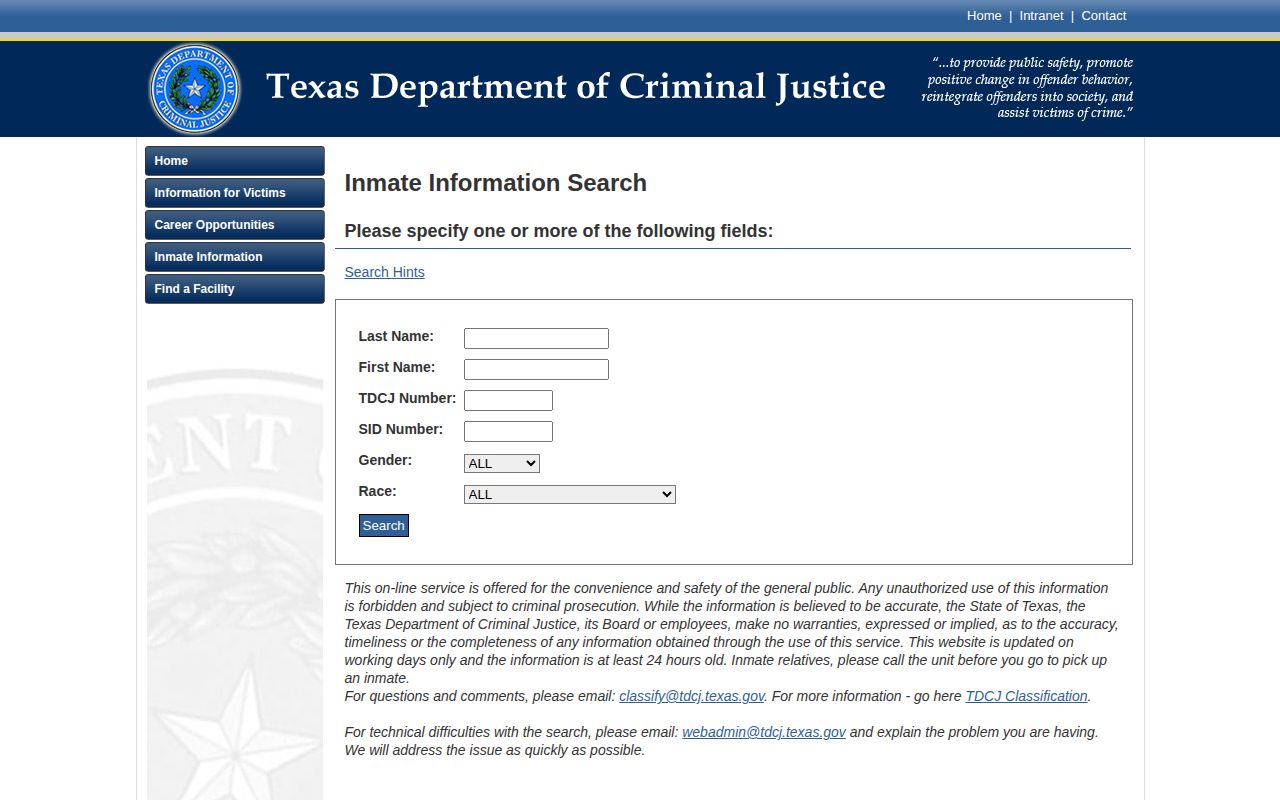
These fields do not cover a person whose custody never moved beyond the Harris County jail.
Harris County Release Evidence
Match each claim to its strongest record. The HCSO release sheet proves the county departure and disposition. A TDCJ certificate documents a supervised state release. An agency discharge record shows the sentence obligation ended. A docket or certified judgment explains the legal sentence, but it may not prove the physical exit time.
When a state prisoner vanishes from the current-only search, request incarceration history or release information by email or through the TDCJ Public Information Act route. Give the TDCJ number, SID, conviction county, and date range. Ask for existing records showing confinement dates and the date and legal mode of release or discharge.
Note: Confirm the destination as well as the date because a transfer ends one agency's custody while another agency's custody begins.
Harris County Parole Date Meaning
Parole eligibility and parole release are separate stages. Eligibility means the sentence has reached a point at which BPP may review the case under the applicable statute. It does not require approval. A favorable vote may call for an investigation, program, or special condition before TDCJ issues the certificate. New disciplinary or case information can cause reconsideration.
Ask for the exact BPP code and use the current official definition. An NR result may set a later review. A serve-all result has a different effect. Mandatory supervision has its own rules. None should be translated into a guaranteed Harris County release date without later TDCJ processing.
After actual supervised release, the certificate can identify conditions and reporting duties. It is stronger evidence than an old projected field. A person may remain under Parole Division authority at a Houston residential reentry center even though prison custody ended. Release from a unit is not sentence discharge.
Harris County Day-Of Confirmation
Check again before travel. TDCJ advises families to call the unit because scheduled dates may change. State prison release logistics must not be applied to the Harris County jail. HCSO publishes no guaranteed county release hour.
For a county booking, call 713-755-5300 and ask whether all HCSO holds cleared, whether physical release occurred, and whether the result was community release or transfer. Bond posting can precede release while staff validate the instrument, check all cases and holds, and complete records, account, property, and medical steps.
A narrow records request can close a gap. Ask for the booking sheet, release sheet, custody disposition, destination, and date and time of physical release. Texas agencies produce existing public records subject to law; they need not create a new narrative answer. That distinction matters when the public page shows only a terse OUT DATE.
Harris County Records Request Route
When an online date disappears or conflicts with the judgment, ask the agency that calculated it for an existing record. For HCSO, identify the full name, DOB, SPN, booking period, and cause number. Request the commitment, jail-time computation, release sheet, date and time of physical release, and disposition or destination. No flat release-sheet fee is published; HCSO says it will send responsive material or advise the charge.
For TDCJ history, start with the general email information route. If a calculation packet, classification record, or other retained file is needed, use the department's formal Public Information Act channel. Name the TDCJ number, SID, conviction county, and date range. Government Code §508.313 and §552.134 may restrict parts of parole or inmate records, so ask for the specific public date and status fields rather than a whole confidential file.
Texas Government Code Chapter 552 calls for prompt production of non-exempt existing information. The well-known ten-business-day provision often concerns an agency request for an Attorney General ruling when it seeks to withhold information; it is not a universal promise that a requester will receive a release packet within ten days. A clear, narrow request reduces avoidable delay.
Harris County Court Date Conflicts
A court judgment sets the sentence, but later records may affect the displayed date. Jail-credit corrections, an amended judgment, a new conviction, concurrent or consecutive terms, and a mandate can change calculation inputs. Search by cause number and obtain the signed instrument when a docket label is too short.
Harris County District Clerk records cover felony and district matters. County Clerk records cover county criminal misdemeanors. Houston Municipal Courts cover city cases. A court disposition may remain available after the live jail record drops away, but the certified disposition proves the legal outcome rather than the exact moment of physical release.
Pair the clerk record with the custody source. That lets the judgment explain why a date exists while HCSO or TDCJ establishes whether the planned event occurred. If the two sources conflict, use the official correction and records channels instead of selecting the more convenient date.